

This story is drawn from real experiences. Protecting my patients’ confidentiality is of utmost importance to me; names, details, and timelines have been changed to honor their privacy, and any similarities to actual persons or events are purely coincidental. The emotional truth remains intact.
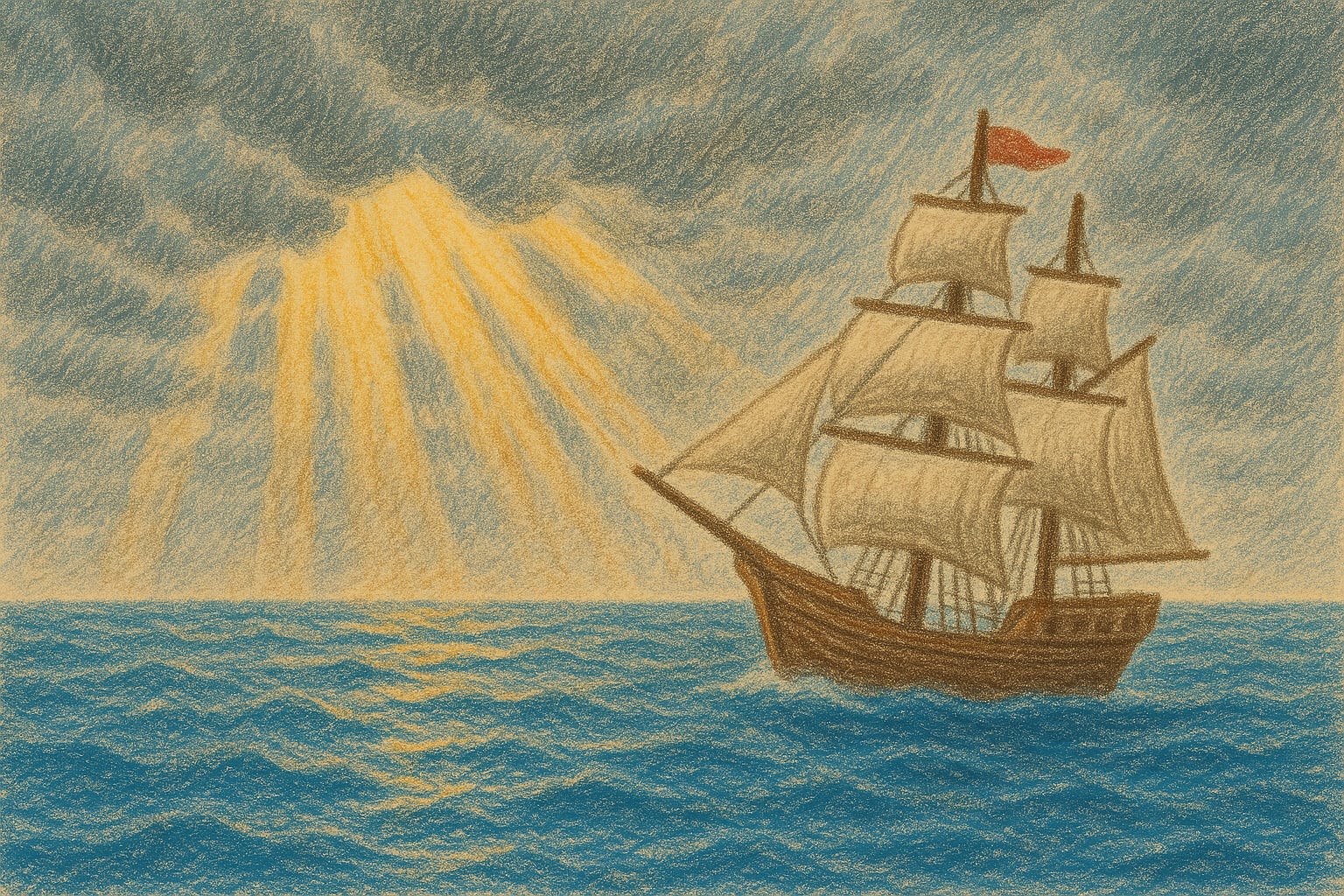
I think our seafaring ancestors’ hearts must have warmed at the sight of crepuscular rays—the sun bursting through the darkness of the storm clouds to illuminate the horizon ahead. It’s a message from our star to earthly explorers, “I’m still here, brave souls. Keep sailing. Ahead is the life you seek.”
Medical residencies are hard. The hours are long, the stress intolerable, and the stories, especially in pediatrics, sometimes crushing. But it’s not all terrible. There are plenty of joyful moments, and from time to time, a memory of one of those precious moments will flit into my mind like a warming ray of light.
As a young intern, I took care of Nadia, a firecracker of a teenager. Nadia had cystic fibrosis. For kids with CF, secretions become an immovable thick sludge. This, of course, is particularly devastating in the lungs. Over time, the sludge becomes worse, and infections take hold—bad ones—ever more resistant to the antibiotics we have. Back when I trained, kids with cystic fibrosis often didn’t survive the teen years.
Nadia’s disease made her an old soul. In her late teens, she had already been through more and had outlived many of her peers and friends. It’s not surprising, then, that Nadia had an edge to her. She knew her disease well and didn’t suffer fools. Such was I when I met her. My first day on service, I went into Nadia’s room and introduced myself. She wasn’t very talkative, but let me ask the same questions she’d answered a million times before. I asked if I could examine her, and after she consented, I began. When I got to her lung exam, I expected to hear a cacophony of copious crackles, but what I got was far more disturbing: nothing. Each time she took those “deep breaths” that we always ask for, I got absolutely no air movement.
I panicked.
This was not good, and I needed help. I clumsily excused myself and nearly sprinted to find my senior resident. Breathlessly, I explained what I’d heard, or rather hadn’t heard. I feared that Nadia would slip unconscious at any moment. He hastily followed me back to the room. When we arrived, we saw Nadia and her roommate nearly crying with laughter. At my expense, it turns out, Nadia had faked chest movement while holding her breath during my exam. A nineteen-year-old with gallows humor? Why not, I guess. My resident patted me on the back and said, “Welcome to the teen ward.” Finally able to control herself, Nadia let me finish my exam but mentioned my red face several times and wondered aloud whether I was sicker than she was.
We lost Nadia about a year after that: her wit, her crankiness, her ball-busting, and her sheer grit, all gone. But I’m left forever with that tiny moment she gave me, a ray of light streaming through the darkness of the years.
Over time, I became a wiser pediatric resident than that blushing intern. Eventually, as a senior resident, I was the one interns were running to for help. It’s always a bit of a crapshoot when you’re assigned your team during your month as senior on the ward. You can get the local talent show quartet, or you can get the Beatles. The latter was my fortune one month as a senior resident on 3 East, a floor primarily for small kids. That month, my interns and medical students were rock stars.
One night, we had been working hard all evening, but things finally slowed down around 11:00 PM. Karla, one of my stellar interns, was “tucking in the kids”, a euphemism for night rounds, when she appeared at the door with one of our cutest patients, little Javier. He was, for reasons unknown, having a bad night. He probably awoke to realize Mama wasn’t there, and he didn’t like it at all. Karla was bouncing him a bit on her hip and comforting him as best she could. We all tried to soothe him with a mix of baby talk and funny faces, but nothing was working. Then I heard the little radio in our call room start playing “I Can See Clearly Now” by Jimmy Cliff. I turned it up, and Karla started dancing with Javy. Soon, I was dancing; the medical student was dancing. A few nurses heard the ruckus and started dancing with us. And Javy? Almost immediately, he was all smiles, and not long after, back asleep, dreaming of rainbows and sunshine.
I don’t know what happened to Javier, and I haven’t kept up with most of the people in that tiny call room that night. But every so often, when I’m feeling a bit blue, I think about that evening with Javy, and our ragtag, scrub-wearing dance troupe.
Gone are the dark clouds that had me blind.
It’s gonna be a bright, bright sun-shining day.
And just like Javy, a smile lives where a frown once did.
This was often the story. A group of people who love kids coming together to make them better and help them smile again. And always, to do it right, we leaned on each other. The weeks were long, the work exhausting in its complexity and importance, and the stories all too often were devastating. I think we tried to stay on the lookout for signs that it was all becoming too much for our friends. I remember one rainy morning after a brutal call, several residents asked if I wanted to join them for breakfast to regroup a bit. Nothing overt, just a small group giving me a chance to see a different world than the one I’d just survived. Exhausted as I was, I jumped at the opportunity.
We, at first, were complaining about how rough the night had been, but soon a few lighter stories started popping up in the conversation. We made fun of our attending and their various neuroses and compulsions. Then we made fun of our own. We saw people walking outside and guessed at their stories. We laughed enviously as we all wondered what it must be like to be them—to have a life.
I’m an old doc now, and my memories of those days have faded. But some moments are frozen in time, like that morning. How young we were to bear such weight. How delighted we were to be together, bonded by trials too much for young souls. But how much easier it was because we were facing it together. We were envious of those nameless faces with lives, walking outside in the rain. I know we didn’t realize it then, but every storm cloud and especially every ray of light, we were part of a bigger journey—our story. We were young explorers, sailing rough seas toward a horizon afire with crepuscular rays, and calmer seas. And a quiet voice reassured, “You’re still here, brave souls. Keep sailing. This is the life you seek.”